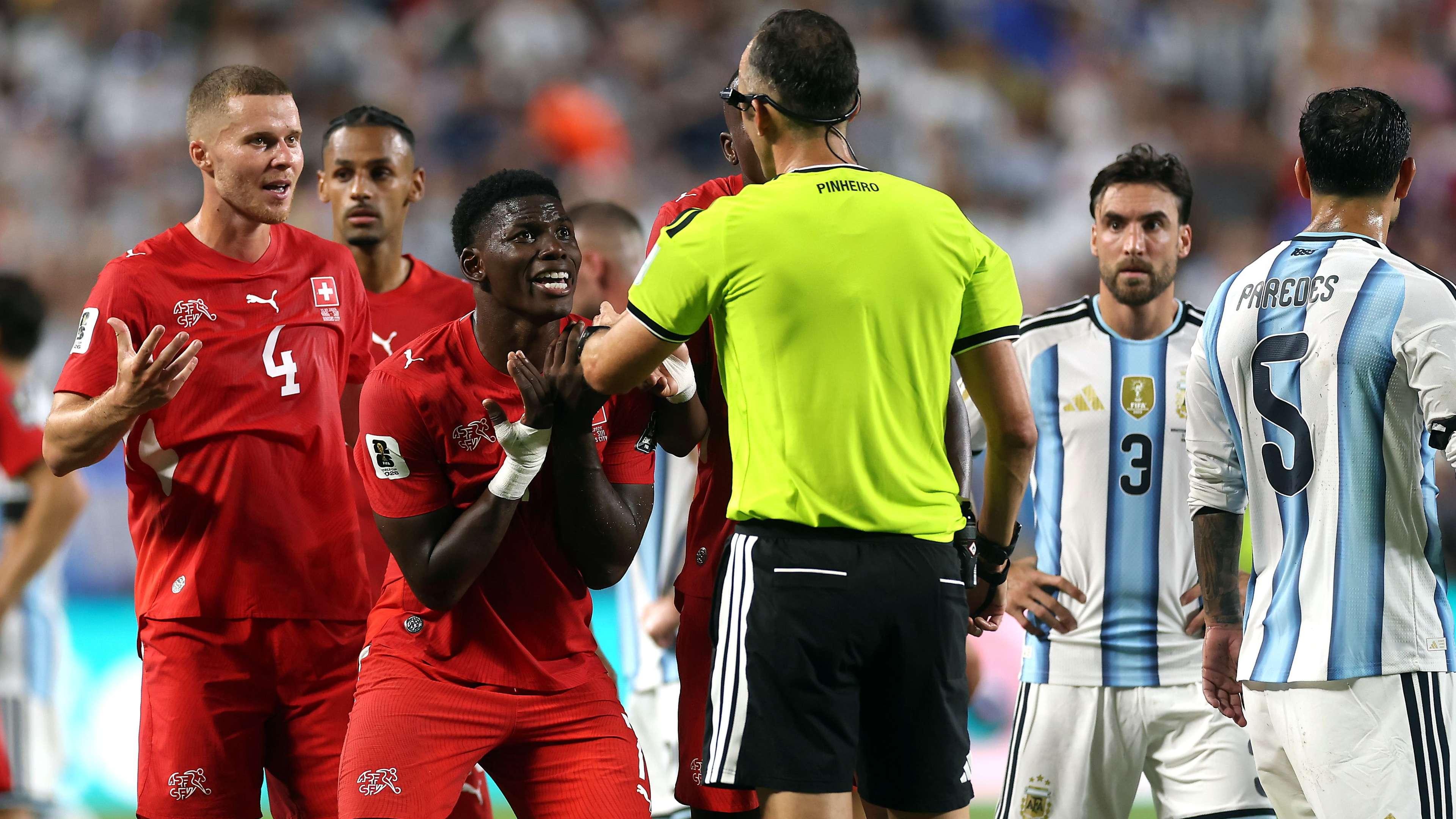
FIFA Defends VAR Decision in Embolo Incident at 2026 World Cup
Football fans were left buzzing with controversy after Switzerland’s Breel Embolo was sent off during the quarter-final clash against Argentina at the 2026 World Cup. The intervention of Video Assistant Referee (VAR) technology in the incident raised eyebrows, but FIFA has come out to defend the decision, citing it as a correct application of the “mistaken identity” clause.
FIFA Stands By VAR Decision
A spokesperson for FIFA stated that the world governing body’s interpretation of mistaken identity was consistently applied throughout the World Cup. The spokesperson explained that there were two cases where a player was mistakenly identified as having committed an offense that warranted a yellow card, and the video referee advised the on-field referee to correct the error.
The spokesperson emphasized that the simulation itself cannot be overlooked and should not result in disciplinary action against an opponent, such as a sending-off or suspension. FIFA maintained that the decision to send off Embolo was a correction in the interest of fairness and justice.
FIFA acknowledged the comments made by the International Football Association Board (IFAB) but reiterated that their interpretation of the incident was correct and aligned with the approved guidelines. The issue will be further discussed during the review of the VAR technology protocol.
Embolo Incident Unpacked
During the quarter-final match between Argentina and Switzerland, an incident involving Breel Embolo and Leandro Paredes sparked controversy. Embolo went down without contact from Paredes, leading to the Argentine being booked. However, after VAR intervention, it was determined that Embolo had simulated the foul, resulting in Paredes’ caution being rescinded and a red card shown to the Swiss forward.
Embolo’s sending off had a significant impact on the game, with Argentina taking advantage of the extra man to secure a 3-1 victory and advance to the semi-finals. This incident mirrored a similar situation in a group stage match between Paraguay and the United States, where Miguel Almiron was cautioned for simulation.
Football enthusiasts and experts continue to debate the use of VAR in such instances, with opinions divided on its effectiveness in ensuring fair play and accurate officiating during high-stakes matches.
As the 2026 World Cup progresses, the role of VAR technology and its impact on crucial decisions will remain a topic of discussion among fans, players, and officials alike.
Keywords: football news, World Cup, FIFA, VAR, Embolo, Argentina, Switzerland, controversy
VAR Technology Evolution in Football
Since its introduction, VAR technology has been a subject of both praise and criticism in the football world. While designed to minimize errors and ensure fairness in decision-making, its implementation has generated mixed reactions among fans, players, and coaches. The incident involving Breel Embolo at the 2026 World Cup once again brought the spotlight on the use of VAR and its impact on the game.
VAR has significantly changed the dynamics of football matches, providing referees with an additional tool to review crucial moments and make more informed decisions. However, the interpretation and application of VAR rules have been a point of contention, as seen in the Embolo incident, where the outcome of the match was influenced by a VAR intervention.
Controversies Surrounding VAR
Despite its intentions to promote fairness and accuracy, VAR has faced several controversies since its inception. Critics argue that VAR disrupts the flow of the game, creates confusion among players and fans, and does not always lead to consistent outcomes. The subjective nature of certain decisions, such as diving or simulation, further complicates the use of VAR in football.
The Embolo incident highlighted the challenges of implementing VAR in situations where subjective judgments are involved. While FIFA defended the decision as a necessary correction, the debate around the impact of VAR on the game’s integrity continues to resonate within the football community.
The Future of VAR in Football
As football evolves and technology advances, the role of VAR in the sport is likely to undergo further scrutiny and refinement. Discussions around improving VAR protocols, enhancing communication between officials, and increasing transparency in decision-making processes are ongoing within FIFA and other football governing bodies.
The 2026 World Cup serves as a testing ground for VAR technology, allowing stakeholders to assess its effectiveness and address any shortcomings. While controversies like the Embolo incident may spark immediate reactions, they also contribute to the collective learning experience aimed at enhancing the overall integrity and fairness of the game.
Conclusion
As football enthusiasts continue to witness the impact of VAR on the sport, it is essential to consider the evolving nature of technology in officiating. While controversies and debates may arise, they serve as opportunities for growth and improvement in how football matches are managed and adjudicated.
Ultimately, the goal of VAR remains to uphold the principles of fair play and justice on the field, ensuring that the game is decided based on skill, strategy, and sportsmanship. The ongoing dialogue surrounding VAR underscores the passionate engagement of football fans worldwide in shaping the future of the beautiful game.
Keywords: football news, World Cup, FIFA, VAR, Embolo, Argentina, Switzerland, controversy, technology, decision-making